NF ISO 13379
Condition monitoring and diagnostics of machines - General guidelines on data interpretation and diagnostics techniques
ISO 13379:2003 gives guidance for data interpretation and diagnostics of machines. It is intended to allow the users and manufacturers of condition monitoring and diagnostics systems to share common concepts in the fields of machine diagnostics; to enable users to prepare the necessary technical characteristics that will be used for the further diagnosis of the condition of the machine; and to give an appropriate approach to achieve a diagnosis of machine faults.Since it gives general guidelines, a list of the machine types addressed is not included. However, the machine sets covered by ISO 13379:2003 will normally include industrial machines such as turbines, compressors, pumps, generators, electrical motors, blowers and fans.
ISO 13379:2003 gives guidance for data interpretation and diagnostics of machines. It is intended to allow the users and manufacturers of condition monitoring and diagnostics systems to share common concepts in the fields of machine diagnostics; to enable users to prepare the necessary technical characteristics that will be used for the further diagnosis of the condition of the machine; and to give an appropriate approach to achieve a diagnosis of machine faults.
Since it gives general guidelines, a list of the machine types addressed is not included. However, the machine sets covered by ISO 13379:2003 will normally include industrial machines such as turbines, compressors, pumps, generators, electrical motors, blowers and fans.
- Avant-proposiv
- Introductionv
-
1 Domaine d'application1
-
2 Références normatives1
-
3 Termes et définitions1
-
4 Préparation de la surveillance et éléments requis pour le diagnostic3
-
4.1 Situation et rôle du diagnostic pour l'exploitation et la maintenance3
-
4.2 Étude des besoins du diagnostic3
-
4.3 Analyse des Symptômes des Modes de Défaillance (ASMD)4
-
4.4 Spécifications du système d'aide au diagnostic8
-
5 Éléments utilisés pour le diagnostic8
-
5.1 Données de surveillance8
-
5.2 Données concernant la machine10
-
5.3 Historique de la machine11
-
6 Démarches de diagnostic11
-
6.1 Choix de la démarche de diagnostic11
-
6.2 Démarche de diagnostic basée sur une association défauts/symptômes11
-
6.3 Démarche de diagnostic par l'analyse causale14
- Annexe A (informative) Analyse des modes de défaillance et des symptômes16
- Annexe B (informative) Efficacité du système de diagnostic19
- Annexe C (informative) Exemple de rapport de diagnostic20
- Annexe D (informative) Exemple de détermination du niveau de confiance dans le diagnostic23
- Annexe E (informative) Exemple d'arbre causal: écaillage de paliers24
- Bibliographie26
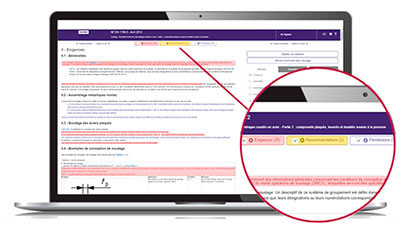
The Requirements department helps you quickly locate within the normative text:
- mandatory clauses to satisfy,
- non-essential but useful clauses to know, such as permissions and recommendations.
The identification of these types of clauses is based on the document “ISO / IEC Directives, Part 2 - Principles and rules of structure and drafting of ISO documents ”as well as on a constantly enriched list of verbal forms.
With Requirements, quickly access the main part of the normative text!

- With a single click, add a new language, the Requirements or Redline+ service and add one or more additional users.
- Whether you are in the process of acquiring a standard or it is already available in your personal space, the UPSELL service is available at every stage to help you understand it and implement it within your organization.
COBAZ is the simple and effective solution to meet the normative needs related to your activity, in France and abroad.
Available by subscription, CObaz is THE modular solution to compose according to your needs today and tomorrow. Quickly discover CObaz!
Request your free, no-obligation live demo
I discover COBAZ