
NF ISO 14837-1

NF ISO 14837-1

April 2006
Standard Current

Mechanical vibration - Ground-borne noise and vibration arising from rail systems - Part 1 : general guidance

ISO 14837-1:2005 provides general guidance on ground-borne vibration generated by the operation of rail systems, and the resultant ground-borne noise in buildings.It lists the factors and parameters that need to be taken into consideration and offers guidance on prediction methods appropriate for a range of circumstances (e.g. to support the assessment of effects on human occupants and sensitive equipment or operations inside the buildings in addition to the predictions required to assess the risk of damage to building structures).Attention is paid in ISO 14837-1:2005 to characteristics of the source: emission (e.g. train, wheel, rail, track, supporting infrastructure); propagation path: transmission (e.g. ground condition, distance); and receiving structures: immission: (e.g. foundations, form of building construction).The guidance covers all forms of wheel and rail systems, from light-rail to high-speed trains and freight. ISO 14837-1:2005 provides guidance for rail systems at-grade, on elevated structures and in tunnels.It does not deal with vibration arising from the construction and maintenance of the rail system. It does not deal with airborne noise. Structure-radiated noise from elevated structures, which can have a significant environmental impact, is also excluded.

Main informations

Collections

National standards and national normative documents

Publication date

April 2006

Number of pages

55 p.

Reference

NF ISO 14837-1

ICS Codes

17.160   Vibrations, shock and vibration measurements
45.080   Rails and railway components
93.060   Tunnel construction

Classification index

E90-011-1

Print number

1 - 24/03/2006

International kinship

Sumary
Mechanical vibration - Ground-borne noise and vibration arising from rail systems - Part 1 : general guidance

ISO 14837-1:2005 provides general guidance on ground-borne vibration generated by the operation of rail systems, and the resultant ground-borne noise in buildings.

It lists the factors and parameters that need to be taken into consideration and offers guidance on prediction methods appropriate for a range of circumstances (e.g. to support the assessment of effects on human occupants and sensitive equipment or operations inside the buildings in addition to the predictions required to assess the risk of damage to building structures).

Attention is paid in ISO 14837-1:2005 to characteristics of the source: emission (e.g. train, wheel, rail, track, supporting infrastructure); propagation path: transmission (e.g. ground condition, distance); and receiving structures: immission: (e.g. foundations, form of building construction).

The guidance covers all forms of wheel and rail systems, from light-rail to high-speed trains and freight. ISO 14837-1:2005 provides guidance for rail systems at-grade, on elevated structures and in tunnels.

It does not deal with vibration arising from the construction and maintenance of the rail system. It does not deal with airborne noise. Structure-radiated noise from elevated structures, which can have a significant environmental impact, is also excluded.

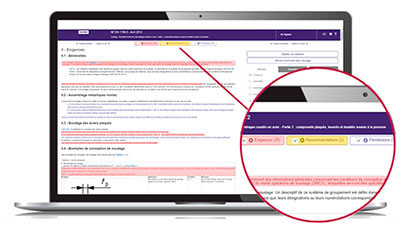
ZOOM ON ... the Requirements department
To comply with a standard, you need to quickly understand its issues in order to determine its impact on your activity.

The Requirements department helps you quickly locate within the normative text:
- mandatory clauses to satisfy,
- non-essential but useful clauses to know, such as permissions and recommendations.

The identification of these types of clauses is based on the document “ISO / IEC Directives, Part 2 - Principles and rules of structure and drafting of ISO documents ”as well as on a constantly enriched list of verbal forms.

With Requirements, quickly access the main part of the normative text!

With Requirements, quickly access the main part of the normative text!
New: UPSELL service
- The UPSELL service allows you to easily update one of your standards.
- With a single click, add a new language, the Requirements or Redline+ service and add one or more additional users.
- Whether you are in the process of acquiring a standard or it is already available in your personal space, the UPSELL service is available at every stage to help you understand it and implement it within your organization.
Need to identify, monitor and decipher standards?

COBAZ is the simple and effective solution to meet the normative needs related to your activity, in France and abroad.

Available by subscription, CObaz is THE modular solution to compose according to your needs today and tomorrow. Quickly discover CObaz!

Request your free, no-obligation live demo

I discover COBAZ