NF ISO 16281
NF ISO 16281

NF ISO 16281

January 2025
Standard Current

Rolling bearings - Methods for calculating the modified reference rating life for universally loaded bearings

This document defines the calculation of the modified reference rating life taking into consideration lubrication, contamination, and fatigue load limit of the bearing material, as well as tilting or misalignment, operating clearance of the bearing and internal load distribution on rolling elements. The calculation method provided in this document covers influencing parameters additional to those described in ISO 281.The general directions and limitations given in ISO 281 apply to this document. The calculation methods pertain to the fatigue life of the bearings. Other mechanisms of failure, like wear or microspalling (gray-staining), lie outside the scope of this document.This document applies to single- and multi-row radial and thrust ball bearings, subjected to radial and axial load and with radial clearance and tilt taken into account. It also applies to single- and multi-row radial and thrust roller bearings, subjected to radial and axial load and with radial clearance, edge stress and tilt taken into account. References to methods for the analysis of the internal load distribution under general load are given.The calculation of load distribution and basic reference rating life is also applicable to hybrid bearings, using the dynamic load ratings per ISO 20056-1[2]. The calculation of the modified reference rating life is not applicable to hybrid bearings.


Main informations

Collections

National standards and national normative documents

Publication date

January 2025

Number of pages

46 p.

Reference

NF ISO 16281

ICS Codes

21.100.20   Rolling bearings

Classification index

E22-396

Print number

1

International kinship

ISO 16281:2025
Sumary
Rolling bearings - Methods for calculating the modified reference rating life for universally loaded bearings

This document defines the calculation of the modified reference rating life taking into consideration lubrication, contamination, and fatigue load limit of the bearing material, as well as tilting or misalignment, operating clearance of the bearing and internal load distribution on rolling elements. The calculation method provided in this document covers influencing parameters additional to those described in ISO 281.

The general directions and limitations given in ISO 281 apply to this document. The calculation methods pertain to the fatigue life of the bearings. Other mechanisms of failure, like wear or microspalling (gray-staining), lie outside the scope of this document.

This document applies to single- and multi-row radial and thrust ball bearings, subjected to radial and axial load and with radial clearance and tilt taken into account. It also applies to single- and multi-row radial and thrust roller bearings, subjected to radial and axial load and with radial clearance, edge stress and tilt taken into account. References to methods for the analysis of the internal load distribution under general load are given.

The calculation of load distribution and basic reference rating life is also applicable to hybrid bearings, using the dynamic load ratings per ISO 20056-1[2]. The calculation of the modified reference rating life is not applicable to hybrid bearings.
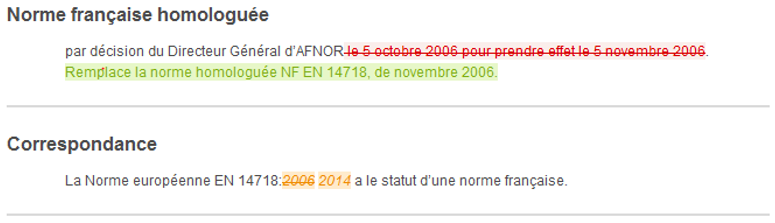
Replaced standards (1)
XP ISO/TS 16281
XP ISO/TS 16281
July 2008
Standard Cancelled
Rolling bearings — Methods for calculating the modified reference rating life for universally loaded bearings

Table of contents
  • 1 Domaine d'application
  • 2 Références normatives
  • 3 Termes et définitions
  • 4 Symboles
  • 5 Analyse de la durée nominale
  • 6 Enfoncement du contact ponctuel et du contact linéaire
  • Annexe A Calcul de la répartition de la charge interne du roulement
  • Annexe B Géométries de référence
  • Annexe C Prise en considération de la surpression due aux effets de bord pour les roulements à rouleaux
  • Annexe D Facteur de correction de durée, aISO, facteur de pollution, eC, limite de charge de fatigue, Cu, et charges dynamiques de base
  • Annexe E Calcul des paramètres hertziens pour un contact ponctuel
  • Annexe F Discontinuités des charges de base et des résultats de la durée nominale
  • Bibliographie
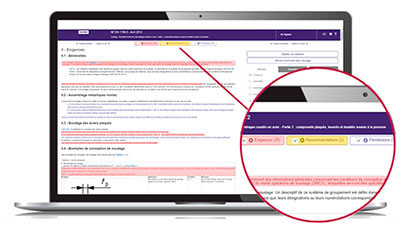
ZOOM ON ... the Requirements department
To comply with a standard, you need to quickly understand its issues in order to determine its impact on your activity.

The Requirements department helps you quickly locate within the normative text:
- mandatory clauses to satisfy,
- non-essential but useful clauses to know, such as permissions and recommendations.

The identification of these types of clauses is based on the document “ISO / IEC Directives, Part 2 - Principles and rules of structure and drafting of ISO documents ”as well as on a constantly enriched list of verbal forms.

With Requirements, quickly access the main part of the normative text!

With Requirements, quickly access the main part of the normative text!
What is the Redline format?
New: UPSELL service
Need to identify, monitor and decipher standards?