

NF ISO 20595
NF ISO 20595

NF ISO 20595

April 2018
Standard Cancelled

Water quality - Determination of selected highly volatile organic compounds in water - Method using gas chromatography and mass spectrometry by static headspace technique (HS-GC-MS)

ISO 20595:2018 specifies a method for the determination of selected volatile organic compounds in water (see Table 1). This comprises among others volatile halogenated hydrocarbons as well as gasoline components (BTXE, TAME, MTBE and ETBE).The method is applicable to the determination of volatile organic compounds (see Table 1) in drinking water, groundwater, surface water and treated waste water in mass concentrations >0,1 µg/l. The lower application range depends on the individual compound, the amount of the blank value and the matrix.

Main informations

Collections

National standards and national normative documents

Publication date

April 2018

Number of pages

31 p.

Reference

NF ISO 20595

ICS Codes

13.060.50   Examination of water for chemical substances

Classification index

T90-212

Print number

2 - mars 2022

International kinship

ISO 20595:2018
Sumary
Water quality - Determination of selected highly volatile organic compounds in water - Method using gas chromatography and mass spectrometry by static headspace technique (HS-GC-MS)

ISO 20595:2018 specifies a method for the determination of selected volatile organic compounds in water (see Table 1). This comprises among others volatile halogenated hydrocarbons as well as gasoline components (BTXE, TAME, MTBE and ETBE).

The method is applicable to the determination of volatile organic compounds (see Table 1) in drinking water, groundwater, surface water and treated waste water in mass concentrations >0,1 µg/l. The lower application range depends on the individual compound, the amount of the blank value and the matrix.

Standard replaced by (1)
NF EN ISO 20595
NF EN ISO 20595
September 2022
Standard Current
Water quality — Determination of selected highly volatile organic compounds in water — Method using gas chromatography and mass spectrometry by static headspace technique (HS-GC-MS)

Table of contents
  • 1 Domaine d'application
  • 2 Références normatives
  • 3 Termes et définitions
  • 4 Principe
  • 5 Interférences
  • 6 Réactifs
  • 7 Appareillage
  • 8 Échantillonnage
  • 9 Mode opératoire
  • 10 Étalonnage
  • 11 Évaluation
  • 12 Expression des résultats
  • 13 Rapport d'essai
  • Annexe A Exemple de colonne de chromatographie en phase gazeuse, de flacon à espace de tête et de septum
  • Annexe B Exemples d'étalons internes
  • Annexe C Exemple de conditions de l'espace de tête et de conditions de chromatographie en phase gazeuse
  • Annexe D Données de performances
  • Bibliographie
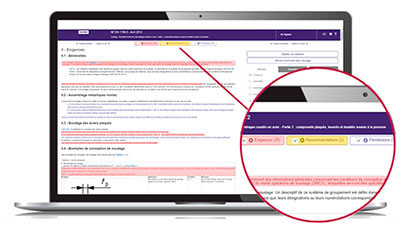
ZOOM ON ... the Requirements department
To comply with a standard, you need to quickly understand its issues in order to determine its impact on your activity.

The Requirements department helps you quickly locate within the normative text:
- mandatory clauses to satisfy,
- non-essential but useful clauses to know, such as permissions and recommendations.

The identification of these types of clauses is based on the document “ISO / IEC Directives, Part 2 - Principles and rules of structure and drafting of ISO documents ”as well as on a constantly enriched list of verbal forms.

With Requirements, quickly access the main part of the normative text!

With Requirements, quickly access the main part of the normative text!
New: UPSELL service
Need to identify, monitor and decipher standards?