
NF ISO 492
NF ISO 492

NF ISO 492

September 2023
Standard Current

Rolling bearings - Radial bearings - Geometrical product specifications (GPS) and tolerance values

This document specifies dimensional and geometrical characteristics, deviation limits from nominal sizes, and tolerance values to define the interface (except chamfers) of radial rolling bearings. Nominal boundary dimensions are defined in ISO 15, ISO 355[2] and ISO 8443[4].This document does not apply to certain radial bearings of particular types (e.g. needle roller bearings) or for particular fields of application (e.g. airframe bearings). Tolerances for such bearings are given in the relevant International Standards.Chamfer dimension limits are given in ISO 582[3].

Main informations

Collections

National standards and national normative documents

Publication date

September 2023

Number of pages

62 p.

Reference

NF ISO 492

ICS Codes

17.040.40   Geometrical Product Specification (GPS)
21.100.20   Rolling bearings

Classification index

E22-335

Print number

1

International kinship

ISO 492:2023
Sumary
Rolling bearings - Radial bearings - Geometrical product specifications (GPS) and tolerance values

This document specifies dimensional and geometrical characteristics, deviation limits from nominal sizes, and tolerance values to define the interface (except chamfers) of radial rolling bearings. Nominal boundary dimensions are defined in ISO 15, ISO 355[2] and ISO 8443[4].

This document does not apply to certain radial bearings of particular types (e.g. needle roller bearings) or for particular fields of application (e.g. airframe bearings). Tolerances for such bearings are given in the relevant International Standards.

Chamfer dimension limits are given in ISO 582[3].

Replaced standards (1)
NF ISO 492
NF ISO 492
February 2016
Standard Cancelled
Rolling bearings — Radial bearings — Geometrical product specifications (GPS) and tolerance values

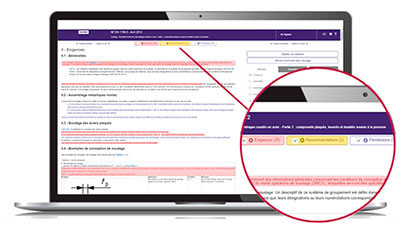
ZOOM ON ... the Requirements department

To comply with a standard, you need to quickly understand its issues in order to determine its impact on your activity.

The Requirements department helps you quickly locate within the normative text:

  • mandatory clauses to satisfy,
  • non-essential but useful clauses to know, such as permissions and recommendations.

The identification of these types of clauses is based on the document "ISO/IEC Directives, Part 2 - Principles and rules of structure and drafting of ISO documents" as well as on a constantly enriched list of verbal forms.

With Requirements, quickly access the main part of the normative text!


What is the Redline format?
New: UPSELL service
Need to identify, monitor and decipher standards?