NF P15-202-1

NF P15-202-1

February 2004
Standard Cancelled

DTU 27.1 - Building works - Coverings from blown-out mineral fibres with binder - Part 1 : technical specifications

Le présent document constitue un cahier des clauses techniques pour la mise en oeuvre des revêtements réalisés par projection pneumatique de produits élaborés à partir de laines minérales avec liant sur parois ou structures de bâtiment.

Main informations

Collections

National standards and national normative documents

Publication date

February 2004

Number of pages

35 p.

Reference

NF P15-202-1

ICS Codes

91.100.60   Thermal and sound insulating materials

Classification index

P15-202-1

Print number

1 - janvier 2004
Sumary
DTU 27.1 - Building works - Coverings from blown-out mineral fibres with binder - Part 1 : technical specifications

Le présent document constitue un cahier des clauses techniques pour la mise en oeuvre des revêtements réalisés par projection pneumatique de produits élaborés à partir de laines minérales avec liant sur parois ou structures de bâtiment.
Replaced standards (1)
NF P15-202-1
May 1993
Standard Cancelled
DTU 27-1. Building works. Coverings from blown-out mineral fibres with binder. Part 1 : technical specifications.

La présente norme propose les clauses techniques à insérer dans un marché d'exécution de revêtements réalisés par projection pneumatique sur des parois ou structures de bâtiment, de produits élaborés à partir de fibres minérales (à l'exclusion de l'amiante) avec liant.

Standard replaced by (2)
NF DTU 27.1 P1-1
August 2019
Standard Cancelled
Building works - Coverings from blown-out slag mineral fibers with binder - Part 1-1 : Contract bill of technical model clauses

NF DTU 27.1 P1-2
August 2019
Standard Cancelled
Building works - Coverings from blown-out slag mineral fibers with binder - Part 1-2 : General criteria for selection of materials

Table of contents
  • Introduction
    5
  • 1 Domaine d'application
    5
  • 2 Références normatives
    5
  • 3 Définition
    7
  • 4 Produits et matériaux
    7
  • 4.1 Le mélange spécifique à projeter
    7
  • 4.2 Le primaire d'accrochage
    8
  • 4.3 L'armature d'accrochage éventuelle
    8
  • 4.4 Le revêtement de finition éventuel
    8
  • 5 Matériel de projection
    8
  • 6 Mise en oeuvre
    9
  • 6.1 Conditions générales
    9
  • 6.2 Préparation du support
    9
  • 6.3 Projection
    11
  • 6.4 État de surface
    11
  • 6.5 Points singuliers
    11
  • 7 Sécurité incendie
    12
  • 7.1 Principes généraux
    12
  • 7.2 Réaction au feu du revêtement
    12
  • 7.3 Résistance au feu des éléments de construction protégés
    12
  • 8 Correction acoustique
    13
  • 9 Isolation thermique
    13
  • 10 Aptitude à l'usage
    13
  • 11 Vérifications sur chantier
    14
  • 11.1 Acceptation des épaisseurs réelles
    14
  • 11.2 Contrôle d'adhérence et de cohésion
    14
  • 11.3 Masses volumiques
    15
  • 12 Entretien
    15
  • Annexe A
    (normative) Caractéristiques requises pour les différentes fonctions recherchées 16
  • Annexe B
    (normative) Détermination des épaisseurs ponctuelles et moyennes d'un revêtement fibreux 18
  • Annexe C
    (normative) Méthodes de mesure de la masse volumique apparente et de la consommation 20
  • Annexe D
    (normative) Mesure du coefficient d'absorption alpha w 23
  • Annexe E
    (informative) Essais d'absorption - désorption des revêtements "anti-condensation" 24
  • Annexe F
    (normative) Essais d'adhérence 26
  • Annexe G
    (informative) Description et fonctionnement du pénétromètre 27
  • Annexe H
    (informative) Conditions d'usage et d'entretien 28
  • Annexe I
    (informative) Méthode pour la mesure des propriétés d'adhérence des produits de protection incendie appliqués sur des structures acier, béton et mixtes acier/béton (Reprise de la méthode EGOLF) Groupe européen des laboratoires officiels d'essais de résistance au feu 29
  • Annexe J
    (informative) Vieillissement des produits de protection incendie 35
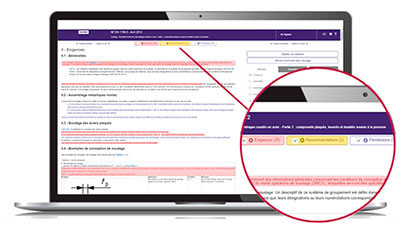
ZOOM ON ... the Requirements department
To comply with a standard, you need to quickly understand its issues in order to determine its impact on your activity.

The Requirements department helps you quickly locate within the normative text:
- mandatory clauses to satisfy,
- non-essential but useful clauses to know, such as permissions and recommendations.

The identification of these types of clauses is based on the document “ISO / IEC Directives, Part 2 - Principles and rules of structure and drafting of ISO documents ”as well as on a constantly enriched list of verbal forms.

With Requirements, quickly access the main part of the normative text!

With Requirements, quickly access the main part of the normative text!
New: UPSELL service
- The UPSELL service allows you to easily update one of your standards.
- With a single click, add a new language, the Requirements or Redline+ service and add one or more additional users.
- Whether you are in the process of acquiring a standard or it is already available in your personal space, the UPSELL service is available at every stage to help you understand it and implement it within your organization.
Need to identify, monitor and decipher standards?

COBAZ is the simple and effective solution to meet the normative needs related to your activity, in France and abroad.

Available by subscription, CObaz is THE modular solution to compose according to your needs today and tomorrow. Quickly discover CObaz!

Request your free, no-obligation live demo

I discover COBAZ