

NF P94-053
NF P94-053

NF P94-053

October 1991
Standard Cancelled

Soils investigation and testing. Determination of density of fine soils. Cutting curb, mould and water immersion methods.

La présente norme concerne la détermination en laboratoire de la masse volumique des sols fins. Elle fixe la terminologie, l'appareillage et le mode opératoire relatifs à cet essai.

Main informations

Collections

National standards and national normative documents

Publication date

October 1991

Number of pages

6 p.

Reference

NF P94-053

ICS Codes

93.020   Earthworks. Excavations. Foundation construction. Underground works

Classification index

P94-053

Print number

1 - octobre 1991
Sumary
Soils investigation and testing. Determination of density of fine soils. Cutting curb, mould and water immersion methods.

La présente norme concerne la détermination en laboratoire de la masse volumique des sols fins. Elle fixe la terminologie, l'appareillage et le mode opératoire relatifs à cet essai.
Standard replaced by (1)
NF EN ISO 17892-2
NF EN ISO 17892-2
December 2014
Standard Current
Geotechnical investigation and testing - Laboratory testing of soil - Part 2 : determination of bulk density

ISO 17892-2:2014 specifies three methods for the determination of the bulk density of soils, comprising: a) linear measurement method; b) immersion in fluid method; c) fluid displacement method. ISO 17892-2:2014 is applicable to the laboratory determination of the bulk density of soil within the scope of geotechnical investigations. The linear measurement method is suitable for the determination of the bulk density of a specimen of soil of regular shape, including specimens prepared for other tests. The specimens used are either rectangular prisms or cylinders with circular cross sections. The immersion in fluid method covers the determination of the bulk density of a specimen of natural or compacted soil by measuring its mass in air and its apparent mass when suspended in fluid. The method may be used when lumps of material of suitable size can be obtained. The fluid displacement method covers the determination of the bulk density of a specimen of soil by measuring its mass in air and the mass of fluid displaced by immersion. The method may be used when lumps of material of suitable size can be obtained. If the immersion in fluid method or fluid displacement method is used, and if the fluid is likely to penetrate into the specimen (eg water) the specimen should be coated before testing to prevent fluid penetration. The bulk density of a soil is useful in the determination of the in situ overburden stress as a function of depth. If required, the dry density of a specimen may be calculated from the bulk density and the water content, if known.

ZOOM ON ... the Requirements department

To comply with a standard, you need to quickly understand its issues in order to determine its impact on your activity.

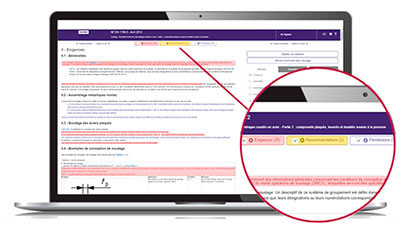
The Requirements department helps you quickly locate within the normative text:

  • mandatory clauses to satisfy,
  • non-essential but useful clauses to know, such as permissions and recommendations.

The identification of these types of clauses is based on the document "ISO/IEC Directives, Part 2 - Principles and rules of structure and drafting of ISO documents" as well as on a constantly enriched list of verbal forms.

With Requirements, quickly access the main part of the normative text!


New: UPSELL service
Need to identify, monitor and decipher standards?