

NF T75-229
NF T75-229

NF T75-229

November 2009
Standard Current

Essential oil of sassafras (Cinnamomum micranthum Hay)

Le présent document spécifie certaines caractéristiques de l'huile essentielle de Sassafras (Cinnamomum micranthum Hay), de la famille des Lauracées, destinées à faciliter l'appréciation de sa qualité.

Main informations

Collections

National standards and national normative documents

Publication date

November 2009

Number of pages

9 p.

Reference

NF T75-229

ICS Codes

71.100.60   Essential oils

Classification index

T75-229

Print number

1 - novembre 2009
Sumary
Essential oil of sassafras (Cinnamomum micranthum Hay)

Le présent document spécifie certaines caractéristiques de l'huile essentielle de Sassafras (Cinnamomum micranthum Hay), de la famille des Lauracées, destinées à faciliter l'appréciation de sa qualité.
Replaced standards (1)
NF T75-229
NF T75-229
June 1982
Standard Cancelled
Essential oils. Oil of brazilian sassafras.

Table of contents
  • 1 Domaine d'application
    4
  • 2 Références normatives
    4
  • 3 Termes et définitions
    4
  • 4 Spécifications
    4
  • 4.1 Aspect
    4
  • 4.2 Couleur
    4
  • 4.3 Odeur
    5
  • 4.4 Densité relative à 20 C, d20/20
    5
  • 4.5 Indice de réfraction à 20 °C
    5
  • 4.6 Pouvoir rotatoire à 20 °C
    5
  • 4.7 Miscibilité à l'éthanol à 20 °C
    5
  • 4.8 Profil chromatographique
    5
  • 4.9 Point d'éclair
    5
  • 5 Échantillonnage
    6
  • 6 Préparation de l'échantillon pour essai
    6
  • 7 Méthodes d'essai
    6
  • 8 Emballage, étiquetage, marquage et stockage
    6
  • Annexe A (informative) Chromatogrammes types de l'analyse par chromatographie en phase gazeuse de l'huile essentielle de sassafras
    7
  • A.1 Chromatogramme type réalisé sur colonne apolaire
    8
  • Annexe B (informative) Point d'éclair
    9
  • B.1 Informations générales
    9
  • B.2 Point d'éclair de l'huile essentielle de sassafras
    9
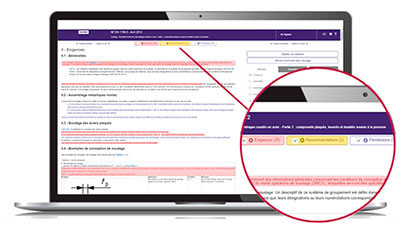
ZOOM ON ... the Requirements department
To comply with a standard, you need to quickly understand its issues in order to determine its impact on your activity.

The Requirements department helps you quickly locate within the normative text:
- mandatory clauses to satisfy,
- non-essential but useful clauses to know, such as permissions and recommendations.

The identification of these types of clauses is based on the document “ISO / IEC Directives, Part 2 - Principles and rules of structure and drafting of ISO documents ”as well as on a constantly enriched list of verbal forms.

With Requirements, quickly access the main part of the normative text!

With Requirements, quickly access the main part of the normative text!
New: UPSELL service
Need to identify, monitor and decipher standards?