

XP C32-321
XP C32-321

XP C32-321

September 2014
Standard Cancelled

Insulated cables and conductors for installations - Rigid cross-linked polyethylene insulated cables covered with a polyvinylchloride sheath - Series U-1000 R2V and U-1000 AR2V

Main informations

Collections

National standards and national normative documents

Publication date

September 2014

Release date

janvier 2023

Number of pages

21 p.

Reference

XP C32-321

ICS Codes

29.060.20   Cables

Print number

1
Replaced standards (3)
XP C32-321
XP C32-321
March 2014
Standard Cancelled
Insulated cables and flexible cords dor installations - Cross-linked polyethylene insulated cables covered with a polyvinylchloride sheath - Series U-1000 R2V and U-1000 AR2V

Le présent document s'applique aux conducteurs et câbles isolés pour installations des séries U-1000 R2V et U-1000 AR2V. Il définit la constitution, les caractéristiques et les essais de vérification correspondants auxquels ils doivent satisfaire.

NF C32-321
NF C32-321
April 1982
Standard Cancelled
Insulated cables and flexible cords for installations. Crossed-linked polyethylene insulated cables covered with a polyvinyl chloride sheath.

NF C32-321 F1
NF C32-321 F1
June 2004
Standard Cancelled
Fiche d'interprétation de la norme NF C32-321 d'avril 1982 et de son amendement 1 d'avril 1993

Standard replaced by (1)
NF C32-321
NF C32-321
August 2022
Standard Current
Insulated cables and conductors for installations - Rigid cross-linked polyethylene insulated cables covered with a polyvinylchloride sheath - Series U-1000 R2V and U-1000 AR2V

Le présent document s'applique aux câbles rigides isolés au polyéthylène réticulé, revêtus d'une gaine en polychlorure de vinyle, de tension assignée 0,6/1 kV. Il donne les conditions auxquelles doivent satisfaire les câbles des séries U-1000 R2V et U 1000 AR2V pour donner toute garantie de sécurité et de durée d'utilisation, lorsqu'ils sont utilisés conformément aux dispositions de la norme NF C 15-100.

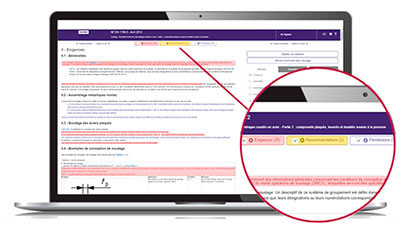
ZOOM ON ... the Requirements department

To comply with a standard, you need to quickly understand its issues in order to determine its impact on your activity.

The Requirements department helps you quickly locate within the normative text:

  • mandatory clauses to satisfy,
  • non-essential but useful clauses to know, such as permissions and recommendations.

The identification of these types of clauses is based on the document "ISO/IEC Directives, Part 2 - Principles and rules of structure and drafting of ISO documents" as well as on a constantly enriched list of verbal forms.

With Requirements, quickly access the main part of the normative text!


New: UPSELL service
Need to identify, monitor and decipher standards?