
XP CEN/TS 14751
Welding - Use of tim-of-flight (TOFD) technique for examination of welds
Le présent document spécifie l'application de la technique de diffraction des temps de vol (méthode TOFD) pour le contrôle par ultrasons semi-automatique ou entièrement automatique des assemblages soudés par fusion de matériaux métalliques d'épaisseur égale ou supérieure à 6 mm. Cette technique est essentiellement destinée à être utilisée sur des joints soudés à pleine pénétration de géométrie simple sur plaques, tubes et récipients dans lesquels le métal de base et le métal fondu sont tous les deux constitués d'acier au carbone faiblement allié.
ISO 10863:2011 specifies the application of the time-of-flight diffraction (TOFD) technique to the semi- or fully automated ultrasonic testing of fusion-welded joints in metallic materials of minimum thickness 6 mm. It applies to full penetration welded joints of simple geometry in plates, pipes, and vessels, where both the weld and parent material are low-alloyed carbon steel. Where specified and appropriate, TOFD can also be used on other types of materials that exhibit low ultrasonic attenuation (especially that due to scatter). Where material-dependent ultrasonic parameters are specified in ISO 10863:2011, they are based on steels having a sound velocity of (5 920 ± 50) m/s for longitudinal waves, and (3 255 ± 30) m/s for transverse waves. It is necessary to take this fact into account when examining materials with a different velocity. ISO 10863:2011 makes reference to the basic standard EN 583‑6 and provides guidance on the specific capabilities and limitations of TOFD for the detection, location, sizing and characterization of discontinuities in fusion-welded joints. TOFD can be used as a stand-alone method or in combination with other NDT methods or techniques, for manufacturing inspection, and for in-service inspection. ISO 10863:2011 specifies four testing levels (A, B, C, D) in accordance with ISO 17635 and corresponding to an increasing level of inspection reliability. Guidance on the selection of testing levels is provided. ISO 10863:2011 permits assessment of TOFD indications for acceptance purposes. This assessment is based on the evaluation of transmitted, reflected and diffracted ultrasonic signals within a generated TOFD image. ISO 10863:2011 does not include acceptance levels for discontinuities.
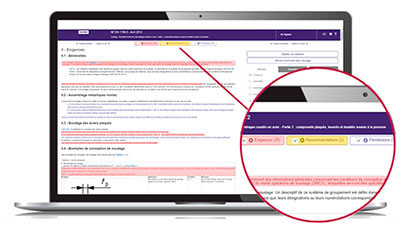
The Requirements department helps you quickly locate within the normative text:
- mandatory clauses to satisfy,
- non-essential but useful clauses to know, such as permissions and recommendations.
The identification of these types of clauses is based on the document “ISO / IEC Directives, Part 2 - Principles and rules of structure and drafting of ISO documents ”as well as on a constantly enriched list of verbal forms.
With Requirements, quickly access the main part of the normative text!

- With a single click, add a new language, the Requirements or Redline+ service and add one or more additional users.
- Whether you are in the process of acquiring a standard or it is already available in your personal space, the UPSELL service is available at every stage to help you understand it and implement it within your organization.
COBAZ is the simple and effective solution to meet the normative needs related to your activity, in France and abroad.
Available by subscription, CObaz is THE modular solution to compose according to your needs today and tomorrow. Quickly discover CObaz!
Request your free, no-obligation live demo
I discover COBAZ