
XP ISO/TS 13399-100
Cutting tool data representation and exchange - Part 100 : definitions, principles and methods for reference dictionaries
ISO/TS 13399-100:2008 defines the principles and methods for creating unambiguous identifications and definitions of the items and their properties relating to cutting tools in computer-sensible dictionaries to be used for reference by the information model defined in ISO 13399-1. It is applicable to:the specification of data element types, their identifying, semantic and value attributes;the specification of item classes, their identifying and semantic attributes;the specification of feature classes, their identifying and semantic attributes.It is not applicable to:information model for cutting tools;classifications and definitions of items and data element types relating to cutting tools;the association between properties and items in a classification.
ISO/TS 13399-100:2008 defines the principles and methods for creating unambiguous identifications and definitions of the items and their properties relating to cutting tools in computer-sensible dictionaries to be used for reference by the information model defined in ISO 13399-1.
It is applicable to:
- the specification of data element types, their identifying, semantic and value attributes;
- the specification of item classes, their identifying and semantic attributes;
- the specification of feature classes, their identifying and semantic attributes.
It is not applicable to:
- information model for cutting tools;
- classifications and definitions of items and data element types relating to cutting tools;
- the association between properties and items in a classification.
ISO/TS 13399-100:2004 defines the principles and methods for creating unambiguous definitions of the items and their properties that relate to cutting tools in computer-sensible dictionaries that are to be used for reference by the information model defined in ISO 13399-1. The following are within the scope of this Technical Specification: the specification of data element types, their identifying, semantic and value attributes;the specification of item classes, their identifying and semantic attributes; The following are not within the scope of this Technical Specification: information model for cutting tools;classifications and definitions of items and data element types relating to cutting tools;association between properties and items in a classification.
- Avant-proposv
- Introductionvii
-
1 Domaine d'application1
-
2 Références normatives1
-
3 Termes et définitions2
-
4 Attributs de spécification des types d'élément de données2
-
4.1 Généralités2
-
4.2 Modèle d'information d'un type d'élément de données4
-
4.3 Types d'élément de données - Attributs d'identification5
-
4.4 Types d'élément de données - Attributs sémantiques9
-
4.5 Types d'élément de données - Attributs de valeur11
-
4.6 Attributs de relation18
-
5 Spécification de classe19
-
5.1 Généralités19
-
5.2 Attributs de spécification de classe20
-
5.3 Modèle d'information d'une classe20
-
5.4 Classe - Attributs d'identification21
-
5.5 Classe - Attributs sémantiques23
-
5.6 Identification externe des classes et des propriétés26
- Annexe A (normative) Enregistrement de l'objet d'information28
- Annexe B (informative) Exemple de développement d'un dictionnaire de référence pour l'ISO 1339929
- Annexe C (informative) Illustration des classes et des propriétés42
- Annexe D (normative) Procédure de mise à jour46
- Annexe E (informative) Définition des caractéristiques d'interface de raccordement51
- Bibliographie55
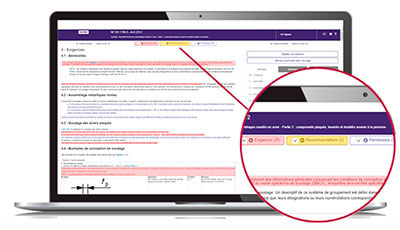
To comply with a standard, you need to quickly understand its issues in order to determine its impact on your activity.
The Requirements department helps you quickly locate within the normative text:
- mandatory clauses to satisfy,
- non-essential but useful clauses to know, such as permissions and recommendations.
The identification of these types of clauses is based on the document "ISO/IEC Directives, Part 2 - Principles and rules of structure and drafting of ISO documents" as well as on a constantly enriched list of verbal forms.
With Requirements, quickly access the main part of the normative text!

- The UPSELL service allows you to easily update one of your standards.
- With a single click, add a new language, the Requirements or Redline+ service and add one or more additional users.
- Whether you are in the process of acquiring a standard or it is already available in your personal space, the UPSELL service is available at every stage to help you understand it and implement it within your organization.
COBAZ is the simple and effective solution to meet the normative needs related to your activity, in France and abroad.
Available by subscription, CObaz is THE modular solution to compose according to your needs today and tomorrow. Quickly discover CObaz!
Request your free, no-obligation live demo
I discover COBAZ