

XP P30-317
XP P30-317

XP P30-317

August 2004
Standard Cancelled

Roofing and wall cladding - Fasteners - Mechanically fastened waterproofing layers and supporting insulating material - Conventional test method for step strengh characteristic for fasteners

Le présent document définit la méthode d'essai conventionnelle de la caractéristique "solide au pas" des fixations destinées à fixer un revêtement d'étanchéité sur tous supports, avec interposition d'un isolant.

Main informations

Collections

National standards and national normative documents

Publication date

August 2004

Number of pages

5 p.

Reference

XP P30-317

ICS Codes

91.060.20   Roofs

Classification index

P30-317

Print number

1 - août 2004
Sumary
Roofing and wall cladding - Fasteners - Mechanically fastened waterproofing layers and supporting insulating material - Conventional test method for step strengh characteristic for fasteners

Le présent document définit la méthode d'essai conventionnelle de la caractéristique "solide au pas" des fixations destinées à fixer un revêtement d'étanchéité sur tous supports, avec interposition d'un isolant.
Standard replaced by (1)
NF P30-317
NF P30-317
November 2006
Standard Current
Roofing and wall cladding - Fasteners - Mechanically fastened waterproofing layers and supporting insulating material - Conventional test method for step strengh characteristic for fasteners

Le présent document a pour objet de définir la méthode d'essai conventionnelle de résistance à l'enfoncement dû à la marche des dispositifs de fixations de revêtements d'étanchéité de toiture et isolants-supports ; cette caractéristique est appelée "solide au pas" pour les fixations. Il s'applique aux attelages (vis + plaquettes), destinés à fixer un revêtement d'étanchéité sur tous supports avec interposition d'un isolant. Il ne s'applique pas aux attelages composés de vis avec manchons plastiques formant plaquettes.

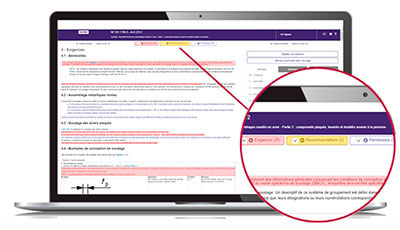
ZOOM ON ... the Requirements department

To comply with a standard, you need to quickly understand its issues in order to determine its impact on your activity.

The Requirements department helps you quickly locate within the normative text:

  • mandatory clauses to satisfy,
  • non-essential but useful clauses to know, such as permissions and recommendations.

The identification of these types of clauses is based on the document "ISO/IEC Directives, Part 2 - Principles and rules of structure and drafting of ISO documents" as well as on a constantly enriched list of verbal forms.

With Requirements, quickly access the main part of the normative text!


New: UPSELL service
Need to identify, monitor and decipher standards?