IEC TR 62284:2003

IEC TR 62284:2003

January 2003
Technical report Cancelled

Effective area measurements of single-mode optical fibres - Guidance

Applies to the methods for measuring the effective area of single mode optical fibres. Three methods of measuring effective area are found in the body of the document. The three methods are: direct far-field (DFF);variable aperture in the far-field (VAMFF); near-field (NF). The reference method, used to resolve disputes, is method A, direct far-field.

Main informations

Collections

International IEC standards

Publication date

January 2003

Number of pages

79 p.

Reference

IEC TR 62284:2003

ICS Codes

33.180.10   Fibres and cables
Sumary
Effective area measurements of single-mode optical fibres - Guidance

Applies to the methods for measuring the effective area of single mode optical fibres. Three methods of measuring effective area are found in the body of the document. The three methods are: direct far-field (DFF);variable aperture in the far-field (VAMFF); near-field (NF). The reference method, used to resolve disputes, is method A, direct far-field.
Standard replaced by (1)
IEC TR 62284:2025
December 2025
Technical report Current
Effective area measurements of single-mode optical fibres - Guidance

IEC TR 62284:2025 which is a Technical Report, applies to single-mode optical fibres. Its object is to document the methods for measuring the effective area (Aeff) of these fibres. It defines three methods of measuring Aeff. Information common to all the methods is found in the body of this document. Information specific to each method is found in the annexes. The three methods are: a) direct far-field (DFF); b) variable aperture in the far-field (VAMFF); c) near-field (NF). The reference method, used to resolve disputes, is method A, direct far-field. Effective area is an optical attribute that is specified for single-mode fibres and used in system designs probably affected by the non-linear refractive index coefficient, n2. There is agreement in both national and international standards bodies concerning the definition used in this document. Methods A, B, and C have been recognised as providing equivalent results, provided that good engineering is used in implementation. The direct far-field is the reference method because it is the most direct method and is named as the reference method for mode field diameter in IEC 60793-1-45 and ITU-T Recommendation G.650.1. A mapping function is a formula by which the measured results of one attribute are used to predict the value of another attribute on a given fibre. For a given fibre type and design, the mode field diameter (MFD) (IEC 60793-1-45) can be used to predict the effective area with a mapping function. A mapping function is specific to a particular fibre type and design. Mapping functions are generated by doing an experiment in which a sample of fibre is chosen to represent the spectrum of values of MFD and in which the fibres in the sample are measured for both MFD and Aeff. Linear regression can be used to determine the fitting coefficient, k, as defined by the following: NOTE 1 Other mathematical models can be used if they are generally more accurate. NOTE 2 See Annex E for more information. This second edition cancels and replaces the first edition published in 2003. This edition constitutes a technical revision. This edition includes the following significant technical changes with respect to the previous edition: a) improvement of the description of measurement details for B-657 fibre; b) modification of the minimum distance between the fibre end and the detector for the direct far field scan (Annex A); c) deletion of Annex H.

ZOOM ON ... the Requirements department
To comply with a standard, you need to quickly understand its issues in order to determine its impact on your activity.

The Requirements department helps you quickly locate within the normative text:
- mandatory clauses to satisfy,
- non-essential but useful clauses to know, such as permissions and recommendations.

The identification of these types of clauses is based on the document “ISO / IEC Directives, Part 2 - Principles and rules of structure and drafting of ISO documents ”as well as on a constantly enriched list of verbal forms.

With Requirements, quickly access the main part of the normative text!
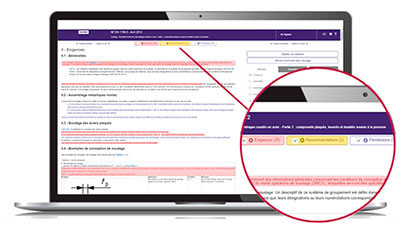
With Requirements, quickly access the main part of the normative text!

Need to identify, monitor and decipher standards?

COBAZ is the simple and effective solution to meet the normative needs related to your activity, in France and abroad.

Available by subscription, CObaz is THE modular solution to compose according to your needs today and tomorrow. Quickly discover CObaz!

Request your free, no-obligation live demo

I discover COBAZ