

NF A50-800-2
NF A50-800-2

NF A50-800-2

November 2007
Standard Cancelled

Hot-rolled weldable aluminium sheets for armouring - Part 2 : firing tests method

Le présent document spécifie la méthode d'essai de tir des tôles en alliage d'aluminium soudable pour blindage d'épaisseur nominale comprise entre 10 et 70 mm, tels que définies dans la NF A 50-800-1.

Main informations

Collections

National standards and national normative documents

Publication date

November 2007

Number of pages

13 p.

Reference

NF A50-800-2

ICS Codes

77.150.10   Aluminium products
95.060   Weapons

Classification index

A50-800-2

Print number

1 - octobre 2007
Sumary
Hot-rolled weldable aluminium sheets for armouring - Part 2 : firing tests method

Le présent document spécifie la méthode d'essai de tir des tôles en alliage d'aluminium soudable pour blindage d'épaisseur nominale comprise entre 10 et 70 mm, tels que définies dans la NF A 50-800-1.
Standard replaced by (1)
NF A50-800-2
NF A50-800-2
August 2014
Standard Cancelled
Hot-rolled weldable aluminium alloy sheets for armouring - Part 2 : ballistic testing method

Le présent document spécifie la méthode d'essai de tir sur des tôles en alliage d'aluminium soudable pour blindage d'épaisseur nominale comprise entre 10 mm et 70 mm, telles que définies dans la NF A 50-800-1.

Table of contents
  • Avant-propos
    4
  • 1 Domaine d'application
    4
  • 2 Définitions
    4
  • 3 Généralités
    4
  • 4 Caractéristiques des projectiles
    5
  • 5 Système de mesure de vitesse
    5
  • 6 Support d'éprouvette
    5
  • 7 Feuille témoin
    5
  • 8 Déroulement de l'essai
    6
  • 8.1 Conditionnement des éprouvettes
    6
  • 8.2 Mode opératoire
    6
  • 9 Rapport d'essai
    7
  • Annexe A (informative) Principales abréviations utilisées lors des essais de tir
    8
  • Annexe B (informative) Exemples d'impacts observables lors des essais de tir
    10
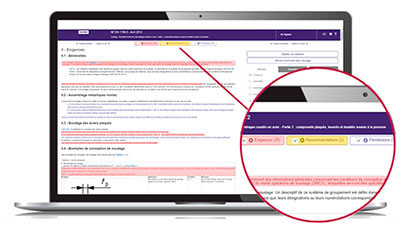
ZOOM ON ... the Requirements department
To comply with a standard, you need to quickly understand its issues in order to determine its impact on your activity.

The Requirements department helps you quickly locate within the normative text:
- mandatory clauses to satisfy,
- non-essential but useful clauses to know, such as permissions and recommendations.

The identification of these types of clauses is based on the document “ISO / IEC Directives, Part 2 - Principles and rules of structure and drafting of ISO documents ”as well as on a constantly enriched list of verbal forms.

With Requirements, quickly access the main part of the normative text!

With Requirements, quickly access the main part of the normative text!
New: UPSELL service
Need to identify, monitor and decipher standards?