

NF EN 10181
NF EN 10181

NF EN 10181

June 1989
Standard Cancelled

Chemical analysis of ferrous materials. Determination of lead in steels. Flame atomic absorption spectrometric method.

La présente norme décrit une méthode de dosage du plomb par spectrométrie d'absorption atomique dans la flamme. La méthode est applicable aux aciers non alliés et faiblement alliés pour des teneurs en plomb comprises entre 0,003 % et 0,5 % (m/m).

Main informations

Collections

National standards and national normative documents

Publication date

June 1989

Number of pages

6 p.

Reference

NF EN 10181

ICS Codes

77.080.20   Steels

Classification index

A08-318

Print number

1 - juin 1989

European kinship

EN 10181:1989
Sumary
Chemical analysis of ferrous materials. Determination of lead in steels. Flame atomic absorption spectrometric method.

La présente norme décrit une méthode de dosage du plomb par spectrométrie d'absorption atomique dans la flamme. La méthode est applicable aux aciers non alliés et faiblement alliés pour des teneurs en plomb comprises entre 0,003 % et 0,5 % (m/m).
Replaced standards (1)
NF A08-318
NF A08-318
October 1985
Standard Cancelled
Chemical analysis of steel and cast iron. Determination of lead content. Flame atomic absorption spectrometric method.

Standard replaced by (1)
NF EN 10181
NF EN 10181
June 2019
Standard Current
Steels - Determination of lead content - Flame atomic absorption spectrometric method (FAAS)

Table of contents
  • 1. OBJET ET DOMAINE D'APPLICATION
  • 2. RÉFÉRENCE
  • 3. PRINCIPE
  • 4. RÉACTIFS
  • 5. APPAREILLAGE
  • 6. ÉCHANTILLONNAGE
  • 7. MODE OPÉRATOIRE
  • 7.1 Prise d'essai
  • 7.2 Essai à blanc
  • 7.3 Dosage
  • 7.4 Établissement de la courbe d'étalonnage
  • 8. EXPRESSION DES RÉSULTATS
  • 9. PROCÉS-VERBAL D'ESSAI
  • ANNEXE : Échantillons testés
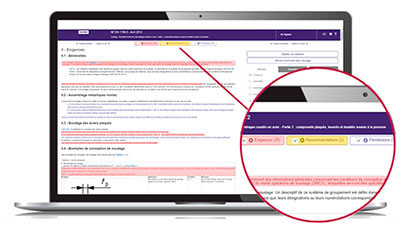
ZOOM ON ... the Requirements department

To comply with a standard, you need to quickly understand its issues in order to determine its impact on your activity.

The Requirements department helps you quickly locate within the normative text:

  • mandatory clauses to satisfy,
  • non-essential but useful clauses to know, such as permissions and recommendations.

The identification of these types of clauses is based on the document "ISO/IEC Directives, Part 2 - Principles and rules of structure and drafting of ISO documents" as well as on a constantly enriched list of verbal forms.

With Requirements, quickly access the main part of the normative text!


New: UPSELL service
Need to identify, monitor and decipher standards?