

NF EN 14531-1
NF EN 14531-1

NF EN 14531-1

September 2005
Standard Cancelled

Railway applications - Methods for calculation of stopping distances, slowing distances and immobilisation braking - Part 1 : general algorithms

Le présent document spécifie un algorithme général à utiliser pour les applications à tout type de véhicule. Il permet de calculer les différents aspects des performances : distances d''arrêt ou de ralentissement, énergie dissipée, calcul des efforts, freinage d''immobilisation.

Main informations

Collections

National standards and national normative documents

Publication date

September 2005

Number of pages

82 p.

Reference

NF EN 14531-1

ICS Codes

45.060.01   Railway rolling stock in general

European kinship

EN 14531-1:2005
Sumary
Railway applications - Methods for calculation of stopping distances, slowing distances and immobilisation braking - Part 1 : general algorithms

Le présent document spécifie un algorithme général à utiliser pour les applications à tout type de véhicule. Il permet de calculer les différents aspects des performances : distances d''arrêt ou de ralentissement, énergie dissipée, calcul des efforts, freinage d''immobilisation.
Standard replaced by (1)
NF EN 14531-1
NF EN 14531-1
March 2016
Standard Cancelled
Railway applications - Methods for calculation of stopping and slowing distances and immobilization braking - Part 1 : general algorithms utilizing mean value calculation for train sets or single vehicles

Le présent document décrit les algorithmes généraux pour les calculs de performance de frein à utiliser pour tous les types de compositions de trains, d''unités ou de véhicules isolés, ce qui inclut la grande vitesse, les locomotives et les voitures de passagers, les véhicules conventionnels et les wagons. Il ne spécifie pas les exigences de performances.

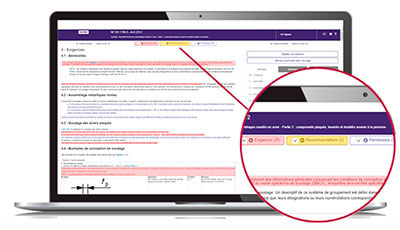
ZOOM ON ... the Requirements department

To comply with a standard, you need to quickly understand its issues in order to determine its impact on your activity.

The Requirements department helps you quickly locate within the normative text:

  • mandatory clauses to satisfy,
  • non-essential but useful clauses to know, such as permissions and recommendations.

The identification of these types of clauses is based on the document "ISO/IEC Directives, Part 2 - Principles and rules of structure and drafting of ISO documents" as well as on a constantly enriched list of verbal forms.

With Requirements, quickly access the main part of the normative text!


New: UPSELL service
Need to identify, monitor and decipher standards?