NF EN ISO 17601

NF EN ISO 17601

June 2018
Standard Cancelled

Soil quality - Estimation of abundance of selected microbial gene sequences by quantitative PCR from DNA directly extracted from soil

ISO 17601:2016 specifies the crucial steps of a quantitative real-time polymerase chain reaction (qPCR) method to measure the abundance of selected microbial gene sequences from soil DNA extract which provides an estimation of selected microbial groups.It is noteworthy that the number of genes is not necessarily directly linked to the number of organisms that are measured. For example, the number of ribosomal operon is ranging from one copy to 20 copies in different bacterial phyla. Therefore, the number of 16S rRNA sequences quantified from soil DNA extracts does not give an exact estimate of the number of soil bacteria. Furthermore, the number of sequences is not necessarily linked to living microorganisms and can comprise sequences amplified from dead microorganisms.

Main informations

Collections

National standards and national normative documents

Publication date

June 2018

Number of pages

42 p.

Reference

NF EN ISO 17601

ICS Codes

13.080.30   Biological properties of soils

Classification index

X31-235

Print number

1

International kinship

European kinship

EN ISO 17601:2018
Sumary
Soil quality - Estimation of abundance of selected microbial gene sequences by quantitative PCR from DNA directly extracted from soil

ISO 17601:2016 specifies the crucial steps of a quantitative real-time polymerase chain reaction (qPCR) method to measure the abundance of selected microbial gene sequences from soil DNA extract which provides an estimation of selected microbial groups.

It is noteworthy that the number of genes is not necessarily directly linked to the number of organisms that are measured. For example, the number of ribosomal operon is ranging from one copy to 20 copies in different bacterial phyla. Therefore, the number of 16S rRNA sequences quantified from soil DNA extracts does not give an exact estimate of the number of soil bacteria. Furthermore, the number of sequences is not necessarily linked to living microorganisms and can comprise sequences amplified from dead microorganisms.

Replaced standards (1)
NF ISO 17601
April 2016
Standard Cancelled
Soil quality - Estimation of abundance of selected microbial gene sequences by quantitative PCR from DNA directly extracted from soil

ISO 17601:2016 specifies the crucial steps of a quantitative real-time polymerase chain reaction (qPCR) method to measure the abundance of selected microbial gene sequences from soil DNA extract which provides an estimation of selected microbial groups. It is noteworthy that the number of genes is not necessarily directly linked to the number of organisms that are measured. For example, the number of ribosomal operon is ranging from one copy to 20 copies in different bacterial phyla. Therefore, the number of 16S rRNA sequences quantified from soil DNA extracts does not give an exact estimate of the number of soil bacteria. Furthermore, the number of sequences is not necessarily linked to living microorganisms and can comprise sequences amplified from dead microorganisms.

Standard replaced by (1)
NF EN ISO 17601
November 2025
Standard Current
Soil quality - Estimation of abundance of selected microbial gene sequences by quantitative polymerase chain reaction (qPCR) from DNA directly extracted from soil

Table of contents
  • 1 Domaine d'application
  • 2 Références normatives
  • 3 Termes et définitions
  • 4 Principe
  • 5 Matériel d'essai
  • 6 Appareillage
  • 7 Mode opératoire
  • 8 Examen des étapes critiques de l'essai de qPCR
  • 9 Expression des résultats de l'essai de qPCR
  • 10 Étude interlaboratoires internationale
  • 11 Rapport d'essai
  • Annexe A Description des principales étapes d'un essai de qPCR TaqMan
  • Annexe B Étude interlaboratoires internationale relative à l'évaluation de la qPCR pour quantifier l'abondance de séquences spécifiques de gènes microbiens à partir d'ADN extrait directement du sol
  • Bibliographie
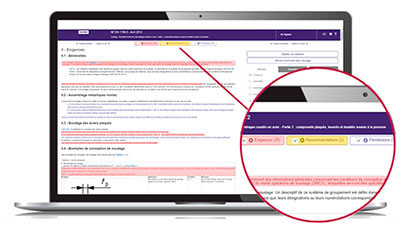
ZOOM ON ... the Requirements department
To comply with a standard, you need to quickly understand its issues in order to determine its impact on your activity.

The Requirements department helps you quickly locate within the normative text:
- mandatory clauses to satisfy,
- non-essential but useful clauses to know, such as permissions and recommendations.

The identification of these types of clauses is based on the document “ISO / IEC Directives, Part 2 - Principles and rules of structure and drafting of ISO documents ”as well as on a constantly enriched list of verbal forms.

With Requirements, quickly access the main part of the normative text!

With Requirements, quickly access the main part of the normative text!
New: UPSELL service
- The UPSELL service allows you to easily update one of your standards.
- With a single click, add a new language, the Requirements or Redline+ service and add one or more additional users.
- Whether you are in the process of acquiring a standard or it is already available in your personal space, the UPSELL service is available at every stage to help you understand it and implement it within your organization.
Need to identify, monitor and decipher standards?

COBAZ is the simple and effective solution to meet the normative needs related to your activity, in France and abroad.

Available by subscription, CObaz is THE modular solution to compose according to your needs today and tomorrow. Quickly discover CObaz!

Request your free, no-obligation live demo

I discover COBAZ