
NF EN ISO 4628-3
NF EN ISO 4628-3

NF EN ISO 4628-3

November 2024
Standard Current

Paints and varnishes - Evaluation of quantity and size of defects, and of intensity of uniform changes in appearance - Part 3 : Assessment of degree of rusting

Main informations

Collections

National standards and national normative documents

Publication date

November 2024

Number of pages

36 p.

Reference

NF EN ISO 4628-3

ICS Codes

87.040   Paints and varnishes

Print number

1

International kinship

ISO 4628-3:2024

European kinship

EN ISO 4628-3:2024
Replaced standards (1)
NF EN ISO 4628-3
NF EN ISO 4628-3
March 2016
Standard Cancelled
Paints and varnishes - Evaluation of degradation of coatings - Designation of quantity and size of defects, and of intensity of uniform changes in appearance - Part 3 : assessment of degree of rusting

ISO 4628-3:2016 specifies a method for assessing the degree of rusting of coatings by comparison with pictorial standards. The pictorial standards provided in this part of ISO 4628 show coated steel surfaces which have deteriorated to different degrees by a combination of rust broken through the coating and visible underrust. NOTE 1 The pictorial standards have been selected from the "European rust scale" published by the European Confederation of Paint, Printing Ink and Artists' Colours Manufacturers' Associations (CEPE), Brussels. The correlation between the ISO scale and the "European rust scale" is given in Annex B, Table B.1. NOTE 2 The correlation between the ISO scale and the rating system of ASTM D 610 is given in Annex B, Table B.2. NOTE 3 The rust formation on uncoated steel surfaces is designated in accordance with ISO 8501‑1 (rust grades A, B, C, and D). ISO 4628‑1 defines the system used for designating the quantity and size of defects and the intensity of changes in appearance of coatings and outlines the general principles of the system. This system is intended to be used, in particular, for defects caused by ageing and weathering, and for uniform changes such as colour changes, for example yellowing.

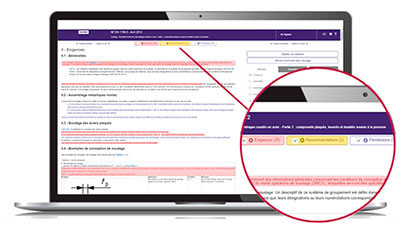
ZOOM ON ... the Requirements department

To comply with a standard, you need to quickly understand its issues in order to determine its impact on your activity.

The Requirements department helps you quickly locate within the normative text:

  • mandatory clauses to satisfy,
  • non-essential but useful clauses to know, such as permissions and recommendations.

The identification of these types of clauses is based on the document "ISO/IEC Directives, Part 2 - Principles and rules of structure and drafting of ISO documents" as well as on a constantly enriched list of verbal forms.

With Requirements, quickly access the main part of the normative text!


What is the Redline format?
New: UPSELL service
Need to identify, monitor and decipher standards?