

NF ISO 10110-8

NF ISO 10110-8

November 1998
Standard Cancelled

Optics and optical instruments. Preparation of drawings for optical elements and systems. Part 8 : surface texture.

Le présent document constitue la huitième partie de la norme NF ISO 10110 relative aux indications sur les dessins d'optique, et s'applique aux indications d'état de surface.

Main informations

Collections

National standards and national normative documents

Publication date

November 1998

Number of pages

14 p.

Reference

NF ISO 10110-8

ICS Codes

01.100.20   Mechanical engineering drawings
37.020   Optical equipment

Classification index

S10-008-8

Print number

1 - 23/12/2004

International kinship

ISO 10110-8:1997
Sumary
Optics and optical instruments. Preparation of drawings for optical elements and systems. Part 8 : surface texture.

Le présent document constitue la huitième partie de la norme NF ISO 10110 relative aux indications sur les dessins d'optique, et s'applique aux indications d'état de surface.
Replaced standards (2)
NF S10-008
August 1980
Standard Cancelled
Optics. Optical lenses. Representation of optical components.

S10-013
April 1986
Standard Cancelled
Optics. Uncoated optical glasses. Surface texture. Roughness.

La présente norme propose différentes méthodes de détermination de la rugosité des pièces optiques non traitées afin d'inscrire sur les dessins la qualité d'état de surface demandée pour ces pièces.

Standard replaced by (1)
NF ISO 10110-8
November 2010
Standard Cancelled
Optics and photonics - Preparation of drawings for optical elements and systems - Part 8 : surface texture - Roughness and waviness

ISO 10110 specifies the presentation of design and functional requirements for optical elements in technical drawings used for manufacturing and inspection. This part of ISO 10110 specifies rules for the indication of the surface texture of optical elements. Surface texture is the characteristic of a surface that can be effectively described with statistical methods. Typically, surface texture is associated with high spatial frequency errors (roughness) and mid-spatial frequency errors (waviness). This part of ISO 10110 is primarily intended for the specification of polished optics. This part of ISO 10110 describes a method for characterizing the residual surface that is left after detrending by subtracting the surface form.

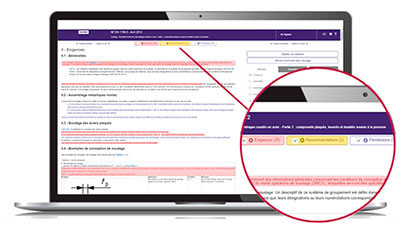
ZOOM ON ... the Requirements department
To comply with a standard, you need to quickly understand its issues in order to determine its impact on your activity.

The Requirements department helps you quickly locate within the normative text:
- mandatory clauses to satisfy,
- non-essential but useful clauses to know, such as permissions and recommendations.

The identification of these types of clauses is based on the document “ISO / IEC Directives, Part 2 - Principles and rules of structure and drafting of ISO documents ”as well as on a constantly enriched list of verbal forms.

With Requirements, quickly access the main part of the normative text!

With Requirements, quickly access the main part of the normative text!
New: UPSELL service
- The UPSELL service allows you to easily update one of your standards.
- With a single click, add a new language, the Requirements or Redline+ service and add one or more additional users.
- Whether you are in the process of acquiring a standard or it is already available in your personal space, the UPSELL service is available at every stage to help you understand it and implement it within your organization.
Need to identify, monitor and decipher standards?

COBAZ is the simple and effective solution to meet the normative needs related to your activity, in France and abroad.

Available by subscription, CObaz is THE modular solution to compose according to your needs today and tomorrow. Quickly discover CObaz!

Request your free, no-obligation live demo

I discover COBAZ